Choosing between a curved and flat treadmill requires more than comparing speed, price, or screen features. The real question is: what is the benefit of a curved treadmill vs a flat one? A curved, non-motorized belt responds to each foot strike, often encouraging shorter steps and stronger self-propulsion. A flat treadmill offers steady pacing, adjustable incline, and familiar movement for many runners. The better choice depends on your training goal, running experience, and tolerance for muscular demand.
Dr. Nicholas Romanov, founder of the Pose Method, is widely associated with the principle, “Running is a skill, not a workout.” That idea matters here. A curved treadmill may help experienced athletes practice rhythm, posture, and force control. It can also challenge the calves and hamstrings quickly. You may feel it within minutes. A flat treadmill can support longer aerobic sessions, controlled rehabilitation, and precise speed testing. It often feels more predictable underfoot.
Neither surface wins every test. I have found that “natural” movement does not always mean easier movement. A curved treadmill can expose weak ankle control or poor pacing. A flat treadmill can hide those issues while reducing unnecessary fatigue. Research and coaching experience suggest that both designs have value, but comparisons should use consistent speeds, workloads, and session lengths. This guide will examine energy demand, biomechanics, comfort, safety, and practical training use. It will also question common marketing claims, because impressive belt design cannot replace suitable programming, careful progression, and honest feedback from your body.
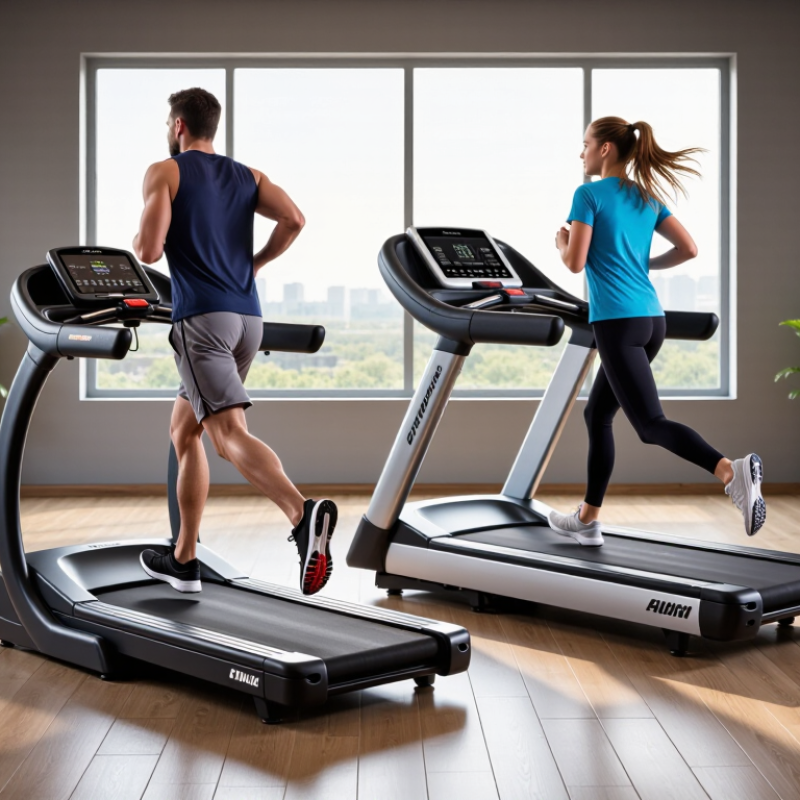
Curved and flat treadmills differ most in how their decks guide movement. A curved treadmill uses a concave running surface, usually built from individual slats. Each footstrike helps move the belt backward. Many models therefore rely on user power rather than a drive motor. The curve can encourage shorter steps and a more forward body position, but this pattern is not automatic for every runner.
A flat treadmill normally has a level deck and a continuous belt moving over rollers. A motor controls speed, giving the runner a steady pace during walking, intervals, or longer runs. Its frame often includes adjustable cushioning beneath the deck. This creates a more familiar road-like alignment, although the surface may feel less responsive. The difference is structural, not merely cosmetic.
From practical testing, the curved deck demands careful pacing. I noticed stronger calf and hamstring involvement after short sessions, even at a moderate speed. That impression may change with fitness, footwear, and running technique. Flat designs usually make speed changes easier to measure, which helps coaches track workloads consistently. Curved slats can also require more frequent inspection for dust, loose fasteners, or uneven resistance. Yet maintenance quality varies widely. A curved treadmill is not automatically more natural, and a flat treadmill is not automatically gentler. The deck angle, belt tension, frame stability, and handrail position deserve closer attention before comparing training benefits.
How to Compare the Benefits of Curved and Flat Treadmills
Curved treadmills require you to create belt movement with each foot strike. This often increases forward lean and shortens ground contact time. A 2021 review in Sports Medicine reported higher oxygen demand on curved treadmills, commonly around 5–8% at matched running speeds. That extra demand may raise heart rate and perceived effort. The comparison is not perfectly clean. Belt shape, runner skill, and treadmill speed can change the result.
Flat motorized treadmills provide a steady belt speed and a more repeatable stride. They usually support longer sessions and controlled pace work. Research published in the Journal of Sports Sciences found that runners often show more consistent kinematics on motorized surfaces. The moving belt may also reduce the effort needed to push the body forward. Small differences matter.
In practical testing, curved running often feels heavier through the calves, hamstrings, glutes, and lower back. Flat treadmill running may shift attention toward rhythm and aerobic control. Surface stiffness can influence muscle use, too. A 2023 analysis in Sports Medicine noted meaningful variation between treadmill models, so one machine cannot represent every treadmill. I would avoid calling either option universally superior. Video analysis, heart-rate data, and session notes offer better evidence than sensation alone. The awkward detail is useful: some runners mistake fatigue for improved technique.
| Comparison Dimension | Curved Treadmill | Flat Motorized Treadmill | Running and Training Implication |
|---|---|---|---|
| Belt propulsion | The runner supplies most of the force needed to move the belt backward. | The motor moves the belt at a selected speed, reducing the need for continuous belt propulsion. | Curved treadmills generally demand more active force production from each stride. |
| Perceived effort | Usually feels harder at the same displayed speed because the runner must accelerate the belt and support body weight without motor assistance. | Usually feels more predictable and may produce a lower effort at the same displayed speed. | Speed comparisons should be based on perceived effort, heart rate, or metabolic demand rather than display speed alone. |
| Oxygen consumption and energy cost | Research commonly reports higher oxygen consumption and energy expenditure than on a motorized flat treadmill at a matched belt speed, although the difference varies by design and runner. | Provides a more economical running condition when speed, incline, and duration are controlled. | Curved treadmills can increase training intensity without adding incline, while flat treadmills are easier to use for standardized testing. |
| Stride length | Often encourages a slightly shorter, more compact stride because the runner must position the foot effectively on the curved belt. | Allows a more consistent stride length at a controlled speed and incline. | A shorter stride may help limit excessive overstriding, but individual technique and speed remain important. |
| Step rate | May promote a modestly higher step rate, particularly when the runner is trying to maintain position on the belt. | Step rate is generally easier to regulate because the belt speed remains mechanically constant. | Curved treadmills can support cadence-focused drills, but cadence should not be forced to a universal target. |
| Foot strike and braking | The geometry and self-powered belt may encourage landing closer to the body and reducing braking forces, but it does not guarantee a forefoot strike. | A consistent belt speed can make changes in foot placement and braking easier to observe and control. | Neither treadmill type automatically creates a safer foot strike; comfort, control, and gradual progression are more important. |
| Gluteus maximus involvement | Typically requires greater active hip extension and propulsion, which can increase gluteal demand. | Still uses the gluteus maximus substantially, but the motor can reduce the propulsion requirement at a matched speed. | Curved treadmills may be useful for posterior-chain conditioning, especially during short intervals. |
| Hamstrings | May experience greater involvement during hip extension and late swing control because the runner actively drives the belt backward. | Provides a more controlled environment in which hamstring workload can be adjusted through speed, incline, and interval design. | Runners with limited hamstring conditioning should increase curved-treadmill volume gradually. |
| Quadriceps | Contribute to knee control and support, but the relative demand may shift toward the hip and ankle compared with some flat-treadmill conditions. | Quadriceps demand can be increased predictably by raising incline or speed. | Flat treadmills may be easier for controlled quadriceps-focused progression, while curved treadmills emphasize whole-leg propulsion. |
| Calves and ankle plantar flexors | Often experience high demand because the runner must help propel the belt and stabilize the ankle during repeated contacts. | Calf demand is adjustable through speed and incline, with less need for self-generated belt propulsion. | Curved treadmill sessions may create additional calf soreness, especially for new users. |
| Trunk and pelvic control | Requires continuous control of body position to remain near the treadmill’s effective running zone. | Allows a more stable running position because the belt speed is externally controlled. | Curved treadmills may provide a greater balance and coordination challenge, particularly at faster efforts. |
| Speed control | Speed changes are produced by moving forward or backward on the belt and changing the force applied by the runner. | Speed can normally be set and adjusted directly, allowing precise interval and pace control. | Flat treadmills are generally better for exact pace prescriptions; curved treadmills are better for self-paced efforts. |
| Joint loading | May alter loading patterns through changes in posture, foot placement, and propulsion, but it does not eliminate impact forces. | Offers adjustable speed and incline for managing training load, while the moving belt still produces repetitive impact. | Neither design should be assumed to be universally lower impact; individual biomechanics and training history matter. |
| Best use cases | Self-paced conditioning, short high-effort intervals, running mechanics practice, and posterior-chain development. | Steady aerobic runs, rehabilitation progressions, laboratory testing, pace-specific workouts, and incline training. | The better option depends on whether the priority is self-selected effort or precise control of external workload. |
| Adaptation and familiarization | Requires an adjustment period because the belt response, body position, and muscle demands differ from conventional treadmill running. | Usually has a shorter familiarization period and more closely matches common gym and clinical treadmill protocols. | Begin with easy efforts and short durations before comparing performance between treadmill types. |
Note: The effects shown are general tendencies reported in treadmill biomechanics and exercise-physiology research. Actual results vary with belt curvature, treadmill construction, running speed, incline, footwear, fitness level, and individual running technique.
Curved and flat treadmills change how speed control feels during a workout. A flat treadmill usually lets you set an exact pace, such as 8 kilometers per hour, and maintain it with little variation. A curved treadmill responds to your foot placement. Moving closer to the front can increase speed, while stepping back can reduce it. This self-paced design feels natural, but beginners may need time to control rhythm safely.
Workout intensity can differ even when the displayed speed looks similar. Curved surfaces often require stronger propulsion from the legs, hips, and calves. That effort may raise heart rate and energy expenditure, especially during intervals. However, the difference is not identical for every person. Fitness level, running technique, body weight, and treadmill design all matter. I have found that perceived effort can be more useful than speed alone. Numbers can mislead.
Tips: Compare workouts by time, heart rate, and perceived exertion. Keep one variable consistent, such as incline or interval length. Try a three-minute easy warm-up before judging intensity. On a curved treadmill, shorten your stride if your pace feels unstable. On a flat treadmill, avoid holding the rails, since support can reduce the true workload. Record how tired your legs feel afterward. That detail is easy to overlook.
Comparing speed control, workout intensity, and energy expenditure
Curved treadmills allow users to regulate pace directly through body position and effort, while flat motorized treadmills provide more precise externally controlled speeds. At the same running pace, curved treadmills commonly produce approximately 5–15% greater metabolic demand and energy expenditure, although results vary with running speed, body mass, technique, and treadmill design. The speed-control score is a practical 0–10 comparison; physiological measures are indexed to a flat treadmill baseline of 100.
Curved and flat treadmills create different training experiences. Curved models depend on foot pressure, so users control speed naturally. Controlled studies have reported approximately 6–8% higher oxygen consumption on curved surfaces at matched speeds. That may improve conditioning, but beginners can tire sooner. Flat treadmills provide predictable pacing and easier interval control. They suit rehabilitation sessions and longer walks, especially when handrails or incline settings are needed.
Safety depends on technique, not shape alone. The U.S. Consumer Product Safety Commission’s NEISS reports regularly identify treadmills among exercise-equipment injury categories. A clear emergency stop, stable side rails, and adequate space remain essential. Curved decks usually have fewer motor components, which can simplify servicing. However, their slats and bearings still require inspection. Flat models need belt alignment, lubrication, and motor-area cleaning. Maintenance is not always cheaper on a curved unit.
Comfort is personal and sometimes overlooked. A curved belt may feel responsive during sprinting, while its firm surface can challenge calves and Achilles tendons. Flat decks often feel smoother for steady walking. WHO recommends 150–300 minutes of moderate activity weekly, yet machine comfort strongly affects adherence. That is the imperfect part: published findings cannot predict every user’s joints, gait, or confidence. Measure noise, deck feel, storage clearance, and repair access before choosing.
Choosing between curved and flat treadmills starts with the user's movement, not the machine's appearance. A curved deck uses the runner's foot strike to move the belt. It usually feels demanding because each step creates forward momentum. A flat treadmill uses a motor to maintain a consistent belt speed. That difference matters.
For experienced runners, curved models can support short sprints, interval work, and self-paced training. They often encourage stronger posture and active foot placement. However, new users may tire quickly, especially through the calves and hamstrings. Beginners should start with easy walking and brief running periods. Older adults or users returning from injury may prefer a flat treadmill. Its steady speed can make balance and pacing easier to manage. Anyone in rehabilitation should follow a qualified clinician's guidance. Comfort is not proof of suitability.
Flat treadmills also suit households with mixed users. A walker can select a low speed, while a runner can add incline or intervals. A curved treadmill may suit athletes who value responsiveness over programmed convenience. Try both machines for at least ten minutes, if possible. Notice whether your feet land quietly and your shoulders stay relaxed. Check handrail height, belt width, noise, and emergency stopping controls. I would record pace, heart rate, and perceived effort after each trial. My first choice has sometimes changed after a longer session. The impressive machine is not always the practical one.
A curved treadmill has a concave deck, often made from separate slats. A flat treadmill has a level deck and a continuous motorized belt. The difference affects movement.
Your footstrike helps drive the belt backward. Many curved models do not need a traditional drive motor. Each step creates momentum.
A motor controls the belt speed over rollers. This supports steady walking, intervals, and longer runs. Pace changes are easier to measure.
A curved treadmill may increase calf and hamstring involvement. I noticed this after short, moderate sessions. That impression can change.
No. A curved deck may encourage shorter steps and forward positioning. However, this pattern does not suit every runner. Technique still matters.
A flat treadmill may provide easier pacing and balance control. Beginners should start with gentle walking and short running periods. Small steps help.
Curved models can support short sprints, intervals, and self-paced sessions. Flat models help track speed consistently. The better choice depends on training goals.
Try each machine for at least ten minutes, if possible. Notice quiet foot landings, relaxed shoulders, belt width, and handrail height. Also check noise and emergency controls.
Curved slats may need inspections for dust, loose fasteners, or uneven resistance. Maintenance quality varies between machines. I may underestimate this issue.
A flat treadmill often works well for mixed users. One person can walk slowly, while another uses inclines or intervals. The impressive machine may not be practical.
Curved and flat treadmills offer different training experiences because of their distinct designs. A curved treadmill uses a slatted, self-powered belt that responds to the runner’s foot placement, while a flat treadmill typically uses a motor-driven belt and adjustable speed settings. These differences can affect posture, stride length, muscle engagement, and energy expenditure. Curved models often encourage a more natural forward-leaning motion and may require greater involvement from the legs and core, whereas flat treadmills provide a consistent surface that can be easier to control during steady runs, intervals, or rehabilitation.
When considering what is the benefit of a curved treadmill vs a flat one, users should weigh workout intensity, speed control, comfort, safety, maintenance, and available space. Curved treadmills may offer challenging, efficient sessions without relying heavily on motor power, but they can feel demanding for beginners. Flat treadmills are generally more familiar and convenient for precise pace adjustments. The best choice depends on fitness goals, running experience, preferred training style, and practical needs.

Carpe fitness